Beartown, by Fredrik Backman

I understand Beartown: Always the afterthought, populated by misfits and hard-working scrappers, looking down the road with envy at Hed, the town next door that always gets the money, the jobs, the attention. Anyone who grew up in Battle Creek, Michigan, just down the road from Kalamazoo, as I did, understands the dynamic. Throw in a rivalry between the towns’ two ice-hockey clubs, populate the story with the kinds of characters that both small towns and ice hockey attract, and you have a surprising, insightful, emotional book that is about so much more than sports.

When we first are introduced to Beartown, the community is on a nervous high, waiting for the town’s junior ice-hockey team to compete in a huge national semifinal game. For once, the team—and by extension, the town—has a real chance to come out a winner, thanks to Kevin, the star player, and the Beartown team that has grown up around him. But things don’t go quite as planned: as the game approaches, the community is split apart by a violent act. The decisions that must be made as a result test the loyalty and ethics of Beartown’s residents.

I loved Fredrik Backman’s A Man Called Ove (see Kristie’s review here) so much that I was afraid that I would be disappointed by this book. Silly me. Backman’s deep understanding of emotions, motivations, and relationships made A Man Called Ove shine in its portrayal of an individual; with Beartown, the author masterfully depicts an entire community, making us feel that we know each member, that we’ve sat with them in the Bearskin pub and listened to their innermost thoughts. We root for them to do the right thing, and care about them even when they don’t. We understand the mistakes they make, even if we sometimes find it hard to forgive them.

Backman’s extraordinarily pleasurable writing is worth spending time with, no matter what the subject, and if I were the sort of person who highlights great sentences in a book, Beartown’s pages would have been glowing like a radioactive lemon. The author’s insightful offhand comments and wry humor mark every passage. But perhaps the most unexpected aspect of this book with a boys’ sport at its core was its feminist streak–subtle at first, but by the end of the story, there’s no missing it.

If you know the world of ice hockey well, Backman’s portrayal of the coaches, players, parents, and fans will have you nodding your head and grinning in recognition. But even if you don’t know a faceoff from an offsides, Beartown’s story resonates with its examination of family, community, sacrifice, and what it means to be a good person.

Where the Crawdads Sing, by Delia Owens

where-the-crawdads-sing-cover

Where the Crawdads Sing was the book that you saw everywhere this summer—the season’s “It” book. I’ll be honest, with an “It” book, I usually wait until I’m pretty sure that we don’t have another TwilightFifty Shades of Grey, or Girl on a Train on our hands—or at least until the paperback is released. But I was heading out to the beach and in need of something to hold my attention between naps, so I took a leap and bought the hardcover. I’m not sorry; this was a solid, emotional read with some unexpected twists.

It’s the story of a remarkable girl, Kya, called “the Marsh Girl” by the denizens of the small nearby town on the North Carolina coast. Abandoned as a very young child, first by her beloved mother, then by her older siblings, and finally by her abusive father, she manages to avoid the authorities long enough for them to lose interest in capturing her, then essentially raises herself in the wild. Though a few of the townspeople provide her with subtle assistance, most consider her a freak. As she grows older, a careful friendship with an older boy tempers her loneliness and gives her the tools to educate herself; then a less careful friendship with another young man leads to heartbreak and tragedy.

The book does require some suspension of belief. The idea of a six-year-old girl surviving on her own in the marshes without starving or injuring herself is a bit of a stretch. (On the other hand, I read books where time travel and vampires are de rigueur, so who am I to judge?) I also found it hard to accept Kya’s character development through her relationships–by her late teens she had been abandoned by everyone she ever loved, which made her initial reaction to a major betrayal difficult to process. And the ending, while surprising and emotional, does rely on the reader to avoid thinking too hard about how secrets are revealed.

Still, a good story populated by appealing personalities trumps all for me, and the author does a beautiful job of incorporating the marsh and its wildlife as characters worthy of a lonely young girl’s love. Kya may be lonely, but with the marshland around her, she is never alone.

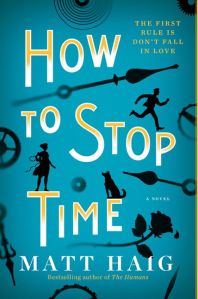
How to Stop Time, by Matt Haig

What if your life expectancy were measured in terms of centuries rather than years? Would it be a blessing or a curse? How would it affect your relationships, your choices, your enjoyment of life?

These are the questions with which How to Stop Time wrangles through its protagonist, Tom Hazard. Tom has been alive since the sixteenth century. His development was normal until puberty, when the ageing process slowed markedly: outwardly, he aged one year for every 15 he lived. The condition comes with a heightened immune system, providing extra protection from diseases. So although Tom isn’t immortal, in many respects he may as well be. He’s over 400 years old, but he looks like a robust 41-year-old.

Tom’s condition is rare, but not unique. There are others like him around the world, and a secretive group has formed to offer support and protection, though its assistance comes with a price. Among other requirements, he must never fall in love. This is not a problem for Tom; his wife, Rose, died during the Black Plague, and even the centuries since haven’t dimmed his love for her. But his emotional isolation is about to be tested as he returns to live in a city brimming with memories of Rose and meets a charming French teacher who draws him in, despite the danger.

This poignant story is dotted with glimpses of history—William Shakespeare plays a key role, as do Captain Cook and Scott and Zelda Fitzgerald—but these mainly serve to provide an entertaining structure for a fantastical romance, and for thoughtful, wry philosophical musings on what it means to live.