
Hey There, Dumpling!: 100 Recipes for Dumplings, Buns, Noodles, and Other Asian Treats, by Kenny Lao

hey there dumpling.jpg


In case there’s anyone out there looking for cookbook recommendations …

I love cooking, and I LOVE cookbooks. Fortunately, I have an understanding partner (Dan) who loves both things as much as I do. Therefore, when I signed up to review this book for NetGalley, we took our job seriously. I downloaded the cookbook, and we set out to cook as many of the recipes as possible. Dan and I have been cooking dumplings for years, so we were pretty sure there wasn’t anything we could learn from this book beyond a few new filling recipes.

Boy, were we wrong.

First, we learned the importance of a good wrapper and the differences between the different styles of wrappers. Although the author offers a recommendation for his preferred wrapper, we tried a few different styles and thicknesses (because, as I said, we took our job seriously!) and came up with the best wrapper available in our area–and it wasn’t the one recommended by the cookbook. If you have a chance, and if you aren’t going to make your own, pick up the PF Select Shanghai-style wrappers for all of your dumplings. You won’t be disappointed. If you can’t find PF Select, the author’s suggestion of Grand Marquis Shanghai-style will do, but they’re a bit more doughy.

Second, we learned new folding styles for dumplings beyond the traditional half-moon.

Third, Kenny Lao has a method for cooking dumplings that is absolutely fantastic. In the past, we’ve fried them, and we’ve steamed them, but his treatment gives you a potsticker that is the best of both worlds and is oh-so-easy. It’s also a great method for making dumplings for a crowd.

Fourth, we were skeptical of Lao’s assertion that freezing the dumplings using his method would yield excellent results. After freezing dumplings based on Lao’s instructions, we have taken to making and freezing dumplings once a month, and we will never return to frozen grocery store dumplings again. There is absolutely no comparison.

Finally, there are the recipes. We tried four different recipes for fillings, two different soups, many of the dipping sauces, and three of the side dishes. All were quite tasty, and we definitely have our favorites.

Overall, this is a great cookbook. The layout is not overwhelming, the recipes are great, and the “how to” sections are clear. Plus, it has a variety of recipes that will appeal to cooks of all skill levels.

We have a lot of detailed notes about specific recipes, but that might be going a bit overboard for this review. Hit me up if you’re interested!

We’ll be buying a copy of this cookbook for ourselves, and we’ll be getting additional copies for friends. We definitely enjoyed our first attempt at cookbook reviewing, and we hope to do many more!

Thank you to the publisher and NetGalley for a copy of the ebook in exchange for my honest review.
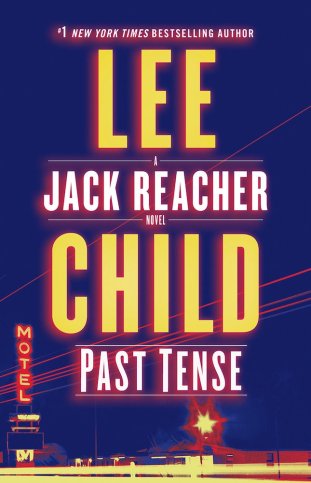
Past Tense, by Lee Child

Past Tense.jpg

I’ve been a fan of Jack Reacher for years. My parents introduced me to him about when book three came out, and I devoured the books in the series as quickly as Lee Child could write them–as did Mom and Dad. I soon introduced my oldest son to Jack … my son was a high school student who wanted to be a US Marine (and has since become one), and he was immediately enthralled. How many authors can have that impact on teens, parents, and grandparents?!

Then Jack and I lost touch for a while, though I thought of him fondly, and probably more often than one should think about a fictional character. When I saw NetGalley was offering up a copy of Lee Child’s soon-to-be-released book, I had to ask for a copy, and I was rewarded with an ebook of PAST TENSE.

If you read Lee Child’s books, you know what to expect. Jack Reacher is wandering through a town, and something keeps him there. The story lines are built on the details surrounding whatever it is that forces his stay in the town in which he finds himself, and Reacher is always Awesome (with a capital A). PAST TENSE follows the formula, and in this instance, Reacher is investigating something is pretty personal: his father’s past. Of course it’s not as simple as hitting the public library, sitting at a computer, going on Ancestry.com, and finding out that everything is exactly as it seems. Nope. This is Jack Reacher, so there are mysteries. And secrets. And fist fights. And there’s another part of the story in which a couple of nice Canadian twenty-somethings are being kept captive in a motel for nefarious purposes. What there *isn’t* is Jack Reacher ending up in bed with miscellaneous female character; that surprised me, but it was actually a relief.

All in all, PAST TENSE is exactly what one expects from of a Lee Child/Jack Reacher book. Reacher is Reacher through and through. The mysteries surrounding his dad and the Canadian captives are intriguing. The action scenes are written really well, and although the slower paced moments made me roll my eyes a bit, I knew there would be some mayhem with just a turn of the page. PAST TENSE isn’t my favorite of the Jack Reacher books, but it does its job and the last half of the book ended up being as entertaining as I had hoped.

My thanks to the publisher and NetGalley for a copy of the ebook in exchange for my honest review.

A Gentleman in Moscow, by Amor Towles

Moscow in 1922 is no place for a count. The Bolsheviks are in charge, and they are not fond of the leisure class. Happily for Count Alexander Ilyich Rostov, there are those who feel that despite his membership in the ranks of the elite, he is a hero of the prerevolutionary cause, thanks to an inspiring poem he published in 1913. Thus, rather than execute him, the Emergency Committee of the People’s Commissariat for Internal Affairs decides that he should be confined to his recent place of residence: Moscow’s grand and glorious Metropol hotel. But if the Count should ever step outside of the building, he will be shot.

Thus begins the splendid story of the Count’s decades-long house arrest. The Count—already, in his own gentlemanly way, a man of the people—may find himself in reduced circumstances, but his charm, humor, and powers of observation will serve him in good stead. He makes his attic hovel into a home and accidentally creates a family out of the Metropol staff and guests.

The cast of characters is delightful: the precocious young girl with a fondness for yellow, whose curiosity cannot be contained (and who ends up giving the Count two precious gifts); the brilliant, temperamental chef; the snooty actress; the warm-hearted seamstress; the officer of the Party with a thirst for knowledge (and for film noir); and many, many more. Each character has a role to play, and all offer the Count ample opportunities for bon mots, erudite ruminations, and cheeky capers.

Though occasionally the author gets a little too cute (the bouillabaisse project comes to mind) and the depiction of Stalinist Russia can be a little too jaunty, all is forgiven when Count Rostov begins to muse–which he does often. He is a gracious and endearing companion, a man who manages to make fine wine from the grapes at hand, and saying adieu to him as the book came to an end was sweet sorrow.

Behind Closed Doors, by B. A. Paris

Ever since Gone Girl, I’ve been waiting for the next great creepy relationship book with a twist. There’s just something about a gripping story in which an attractive façade disguises true, shudder-producing evil. The key to a successful story like that, though, is that its dangers need to be shocking, and its pretty surface needs to be at least passingly believable—we need to be horrified that such evil can live unquestioned in plain sight, and feel the emotional claustrophobia of the situation.

Here’s where Behind Closed Doors fails. We’re introduced to a successful 40-year-old lawyer, the ironically named Jack Angel, who has built his career defending domestic abuse victims. He is smooth, drop-dead gorgeous, and unmarried, and (we later find out) he has built a very pretty house of horror with metal security shutters on all of the downstairs windows on spec. After all, who knows when you’re going to run across the ideal prey? He’s been a creep since he was 13 years old and killed his mother—maybe. But apparently since then he’s gone regularly to Thailand to fulfill his nonspecific terrifying fantasies that don’t include sex with vague, nameless people, as one can apparently do with impunity in Thailand. It seems that he’d really like to up his game, though, and ideally move his horror show closer to home, for convenience. After all, he went to all of that trouble, building the house.

Fortunately for Jack, he eventually happens upon Grace, a young, successful, beautiful, globe-trotting professional woman with ridiculously irresponsible parents and a sister, Millie, who was born with Down’s Syndrome. He courts Grace and quickly wins her devotion by being nice to her sister. They marry hastily, Jack bizarrely skips out on the wedding night, and the next thing Grace knows, she’s in Thailand on her honeymoon, locked outside day after day on a hotel balcony, unable either to go to the bathroom (which I found to be the most chilling part) or to make anyone believe that her brand-new husband is a raving lunatic, despite her best efforts. But then, a thriller that can do no better than “My experience … was made even worse by the knowledge that when Jack wasn’t with me, he was exhilarating in someone else’s fear” is no thriller at all.

When the newlyweds return to the US from this idyllic (for one of them, anyway) wedding trip, Jack continues to hold Grace hostage. Every day, as Jack goes off to work, he locks Grace in an empty room for the day with nothing to do. If Grace somehow displeases him, she is forced to miss a weekend of visitation at Millie’s special boarding school. (Apparently, no one from Millie’s school finds it odd that previously devoted Grace would go almost two months without visiting her sister.) But the real threat is that once Millie graduates, Jack is planning to bring her to live with them and have his totally unspecified nonsexual but terrifying way with her, somehow feeding off of Millie’s fear, which Grace finds too frightening to even contemplate. He puts together a secret red room for Millie (despite the fact that her favorite color is yellow—the horror!) in the pretty house’s basement and decorates it with portraits of battered women that he forces Grace (a very, very amateur painter) to paint as a form of torture. When Grace has been particularly uncooperative, he punishes her with the ultimate form of torture, by making her … sit in the red room looking at the awful portraits she’s painted. The couples with whom he makes her socialize on the weekend and for whom she’s forced to bake perfect souffles have no idea of the anguish Grace is enduring, because she has no way of saying anything—Jack has cut off all access to pens.

As Millie inches closer to leaving her boarding school and coming to live permanently with Jack and Grace in the menacing red room, Grace finally feels the need to take action. Grace’s conundrum is that although she desperately needs to get away from Jack, she knows that in everyone else’s view, he’s Prince Charming. So whatever she plans to do needs to hold up against the judgment of the outside world. In unbelievable fashion, Millie herself hatches a surprising plot, giving Grace an unexpected tool. (What luck that Millie had been recently listening to Agatha Christie audiobooks!) Grace then creates her own elaborate plot and lays the groundwork for carrying it out by demanding a glass of whiskey every night in her prison room. For some reason, once she really puts her foot down, Jack is happy to share a whiskey with her night after night—whew! Thank goodness! Because without that poor decision on his part, Grace is never going to be able to carry out her plan to get out of her empty room and save Millie from the miserable fate of Jack feeding off of her fear in undefined but nonsexual ways!

Author B. A. Paris just doesn’t seem to be able to dredge up the kind of ickiness needed for this kind of story. And there’s really no shame in not having a sick, twisted mind—it just means less fun for the rest of us. With characters and plot that have little grounding in reality, the cringe-worthy questions the book asks on its cover—“The perfect marriage? Or the perfect lie?”—beg for a third option: The perfect dud.

Clock Dance, by Anne Tyler

Even if Anne Tyler’s name hadn’t been prominently displayed on the cover, it would nonetheless have been obvious very quickly that the wispy Clock Dance is an Anne Tyler book, with quirky characters, odd family dinners, a fondness for Baltimore, and a protagonist, 62-year-old Willa, who greets an out-of-the-blue opportunity to shake things up with impulsive decisiveness.

Willa is a mild-mannered harmonizer with a lifelong attraction to people who make use of her peacekeeping skills without ever appreciating them, or her. The backstory in the first third of the book attempts to explain how Willa has come to be living rather uncomfortably in Arizona with her pushy retired second husband, wishing she felt needed, even if she doesn’t quite realize it yet. To start, we see Willa as an 11-year-old dealing with a manic mother, a milquetoast father, and a much younger sister. She makes a clear if unconscious choice at that impressionable age to avoid drama at all costs. We are then shown Willa ten years later, bringing the young man who will become her first husband home from college to meet her parents. We see why she makes the choices that she does, but we also see the behaviors that lead to the next scene, twenty years later, when she loses her first husband in a tragic accident.

Fast forward to the present. Willa is going through the motions, newly settled in Arizona, longing for connections but unable to create them for herself. Then comes a shocking phone call: Her older son’s ex-girlfriend Denise has been shot in Baltimore, she’s in the hospital, she has a 9-year-old daughter, Cheryl, who needs to be looked after, and a neighbor is reaching out to Willa, who is mysteriously listed as an emergency contact on Denise’s phone list. Willa doesn’t know the neighbor, the ex-girlfriend, or the ex-girlfriend’s daughter, but she suddenly sees a chance to be useful, and she barely hesitates in booking a flight.

Once Willa arrives in Baltimore and meets her delightful charges, together with the engaging, eccentric neighbors, there are few surprises. But despite its familiarity, her journey is entertaining. Willa is her usual self: cheery and polite and genteel and, yes, maybe a little superficial. Perhaps in this setting, though, her gift for harmony can be appreciated, and she can learn how to achieve balance between everyone else’s needs and her own.

The reader is left to supply much of the detail regarding Willa’s relationships with her sister and two sons, which are at best strained. One can sense their likely frustration with her terminal inability to take a stand against the forceful personalities she attracts. “Marriage was often a matter of dexterity, in Willa’s experience,” Tyler writes, and we are left to wonder if perhaps what Willa saw as dexterity, those closest to her saw as weakness. The reader can feel the pain and bewilderment that the absence of these key figures in her life causes Willa, perhaps driving what would otherwise be some odd choices in Baltimore.

Anne Tyler leaves her beloved Baltimore to work its magic on Willa, in an ending that’s neat, predictable, but satisfying nonetheless. As the book ends, it’s hard to say goodbye to its inhabitants, particularly level-headed young Cheryl, who loves to bake and is a sweet pastry of a character, with much to teach her surrogate grandmother. We leave Willa in a good place, though, learning that family can have many names and faces, and embracing her serendipitous second chance.

Less, by Andrew Sean Greer

Greer_Less_hc.jpg (480×743)

In the first few pages of Less, I admit, I thought that perhaps I’d made a mistake—or that the Pulitzer Prize committee had, in awarding the book the 2018 prize for fiction. The start of the book felt like a version of what Arthur Less, the central character and a midlist-level author, describes his most recent (rejected) novel to be: “… About a middle-aged gay man walking around San Francisco. And, you know, his … his sorrows….”

“Is it a white middle-aged man?” he is asked. Yes, he admits.

“A white middle-aged man walking around with his white middle-aged American sorrows?”

“Jesus, I guess so,” he answers.

“Arthur. Sorry to tell you this. It’s a little hard to feel sorry for a guy like that.”

“Even gay?”

“Even gay.”

It was a surprise, then, to find myself slowly coming to love the self-esteem-challenged, bumbling, generous, sweet, reluctantly aging, possibly talented–and yes, gay–Arthur, dealing with simultaneously turning fifty and losing his much younger lover by planning a trip around the world. He accepts expenses-paid invitations for odd panels, award ceremonies, and author residencies to finance the journey, which allows him to give a reasonable excuse for turning down an invitation to his ex-lover’s wedding. What could go wrong?

The trip gives Greer an opportunity to gently lampoon the life of a mid-list author—the weird situations, which Arthur accepts genially, and the constant self-doubt, which just adds to Arthur’s unwitting charm. All of his travel adventures are awkward and amusing, but the excursion to Germany is laugh-out-loud funny, largely due to Arthur’s overestimation of his German-speaking talents. I found myself wishing I knew German, so that I could understand the humor here at its deepest level, but truly, the author manages to convey Arthur’s unknowing mistakes and the Germans’ bemusement at his odd pronouncements with skill and endearing humor.

Less is a rather short book, but it nonetheless manages to thoughtfully examine themes of love, family, genius and mediocrity, the creative process, and aging. Illness, tailors, the Odyssey, and Charlie Chaplin all serve to shine light on Arthur’s inner and outer journeys, with gentle pokes at poets and Little League along the way. The main character’s naive innocence and sentimentality are wholly believable and adorable, but they also allow the author to sneak in sharp, humorous, sometimes unexpected observations about the human condition.

When Arthur has made his indelible mark in Mexico, Italy, Germany, Morocco, and India, with a quick trip to Japan on the horizon, he encounters his supposed nemesis, who poignantly cuts to the chase, explaining to Arthur with some reluctance: “You’ve bumbled through every moment and been a fool; you’ve misunderstood and misspoken and tripped over absolutely everything and everyone in your path, and you’ve won. And you don’t even realize it.” Greer does a masterful job of making sure that we laugh at the crazy situations in which Arthur finds himself, at his quirks, occasionally even at his thought processes, but never really at Arthur himself. Because in the heartwarming end, no one can help loving lovable Arthur Less, whether he recognizes it or not.


The Drawing Lesson, by Mark Crilley

the drawing lesson

THE DRAWING LESSON by Mark Crilley is a wonderful approach to learning to draw. A graphic novel combined with an art tutorial, the author/illustrator does a fantastic job weaving his drawing lessons into the story of David and Becky and the time they spend together. David is a young boy who desperately wants to learn to draw well. Becky is an artist who isn’t looking to be an art teacher, but who can’t resist David’s eagerness and his talent.

Crilley’s drawings throughout the novel are simple, but effective. The characters’ emotions shine through, and the story is well developed despite how basic the narrative is. David and Becky aren’t overly complicated artistic figures, and that allows the real star of this book to shine, the art lessons. As Becky teaches David the basics of drawing, their relationship grows along with his skill, and the lessons broaden to show the reader how to navigate life as well as how to complete a drawing: patience; recognizing mistakes and correcting them; and putting time into what you love are highlighted. These are important lessons for readers of all ages, but particularly Crilley’s target age group.

As for the drawing lessons themselves … I can’t rave enough about them. I haven’t seriously tried to draw in over 25 years (though my sitting-in-a-meeting doodles have a fan base), but if I’m reviewing a book on how to draw, I don’t feel I can do it justice without trying to follow along with the book’s lessons. Crilley does an AMAZING job teaching the techniques necessary to draw and draw well. As I did each exercise with the most rudimentary of tools (a mechanical pencil and my college ruled notebook), I produced sketches that had my children dazzled—something that’s not easy to do. Those same children have artistic talent, and I look forward to giving this book to them to see what they can do with it. I’ll also be sharing it with any kids on my gift buying list, and I’ll be recommending it to anyone who will listen.

I can’t stress enough how awesome I found this book to be. Be sure to check it out, and check out Mark’s YouTube channel too. He’s generous with his instruction there as well, and he obviously finds joy in helping others find their inner artist.

My thanks to the publisher for a copy of the book in exchange for my honest review.

Age of Myth, by Michael J. Sullivan

age of myth


AGE OF MYTH is the first book in The Legends of the First Empire, a new series by Michael J. Sullivan. It begins with an excerpt from “The Book of Brin” which sets the story in a land populated by Rhunes (men), and references the gods who live across the river from Rhuneland. Those gods are called Fhrey, and the first chapter describes the death of one of the supposedly immortal Fhrey at the hands of a Rhune named Raithe, who has a bit of help from Malcolm, a Fhrey slave.

In many ways, AGE OF MYTH is your standard epic fantasy. The Fhrey are a very powerful and long-lived race reminiscent of elves in other tales, and some of those Fhrey have learned to harness magic which has led them to view themselves as far superior to everyone else. The news of Raithe killing one of their own reaches Lothian, the fane (leader) of the Fhrey, and that news coincides with information that a member of the Fhrey warrior class has decided to desert his station and take others with him. Thus, Lothian is forced to address both threats, and Arion—one of the magic-wielders—is sent to deal with the problem. Arion heads to Dahl Rehn where the deserter and Raithe have both ended up. Dahl Rehn is a village populated by some great female characters. Persephone is married to the leader of the village and she is his most trusted adviser; Suri is a young mystic who lives in the forest but has ventured to Dahl Rehn with a warning of trouble to come; and Brin is the author of “The Book of Brin”—excerpts from which are found at the beginning of each chapter.

AGE OF MYTH is a tightly written story with action, adventure, wit, and compelling characters. Although the story itself isn’t all that different than others in the genre, the writing, strong women, and flashes of subtle humor help the book shine a little brighter than the standard fantasy offering.

As I noted, I was quite pleased with the power of the female characters in the book. Arion, Persephone, and Suri are obviously stars of AGE OF MYTH, and other women like Tura and Fenelyus provide a strong historical backbone of the story. Many of the males from all the races depicted are despicable and conniving creatures, but Raithe and his sidekick Malcolm are witty, brave, honorable, and fun, and I found myself looking forward to the sections of the book where those two contributed to the action.

The world in which all of these great characters reside is well constructed, and I’m sure that’s owed in part to the fact that AGE OF MYTH is set in the same location as some of Sullivan’s other books.

Another positive to the book is the ending. Some authors struggle to put together an ending that both satisfies and tantalizes when writing a series, but Michael J. Sullivan does it when bringing AGE OF MYTH to a close. I’ve recommended this book and Sullivan’s writing to many, and I look forward to reading more by him.

My thanks to the publisher for a copy of the book in exchange for my honest review.

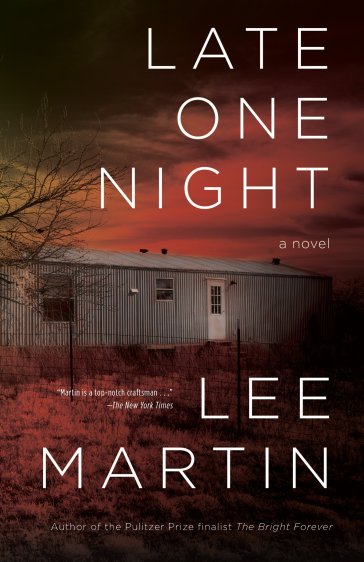
Late One Night, by Lee Martin

late one night


Lee Martin’s LATE ONE NIGHT is one of those books that stays with you long after you read the final page. In it, Ronnie Black’s estranged wife, Della, and three of his seven children are killed when their trailer catches fire on a cold Illinois night. The inhabitants of Della and Ronnie’s hometown of Goldengate have already been talking about the pair for the past several months. After all, Ronnie left Della with their kids and moved in with a younger woman—plus he wasn’t a person who inspired many to defend him even before that.

LATE ONE NIGHT is a wonderful study of a small town. Martin’s characters and dialogue bring Goldengate, Illinois to life, and every reader will find someone they know in its pages. I loved the way each person was made more real in some small way to help me further immerse myself in the story, and by the end of the book I felt as much a member of the town as anyone I read about. Shifting points of view ensured that I always had any needed backstory, and it was done in a way that didn’t leave me scrambling to remember whose brain I was sharing.

Lee Martin has a special gift when it comes to writing literary fiction. He combines suspense and the darker side of people with the comforting rhythm of a small town, and this book is a terrific example of that; Martin captures the wistfulness and yearning for what could have been, the hopes that come with a fresh start, and the suffering caused by a tragedy. It’s one of those rare books that I’ll read again, and I definitely recommend it to others.

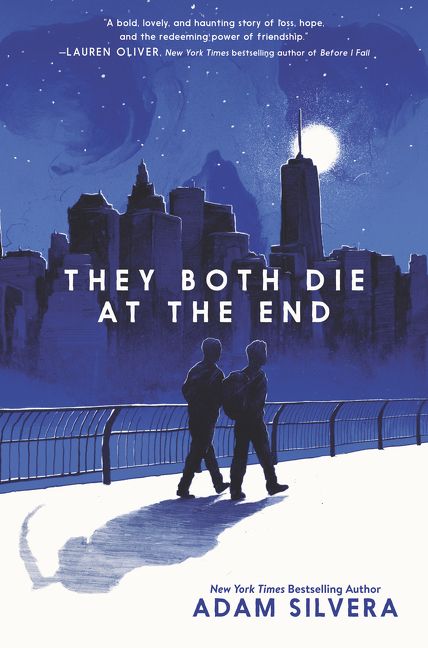
They Both Die at the End, by Adam Silvera

TBDATE


The date is September 5, 2017 and Mateo Torrez and Rufus Emeterio are both going to die. Thanks to an app called Last Friend, they find each other and commit to spend their day in the best way possible—whatever that means.

THEY BOTH DIE AT THE END should be an incredibly sad book about dying, but instead it’s a manual on how to live. Author Adam Silvera shows how we’re all part of a single tapestry, and intersections with others can have a significance you might never understand. Mateo and Rufus are both beautiful souls, and though they are each flawed, their imperfections help strengthen the other. The day that they spend together might seem unremarkable to someone who doesn’t know them; fortunately, we get to know them both really well through some great character development.

In the midst of Mateo and Rufus’s story are the stories of many others. We just catch glimpses of some of them, and others receive a longer look. It’s understandable that none of them are as well put together as the two protagonists, but there are instances where the glimpses seem a bit too contrived and they distract rather than sharpen the focus on the two I really wanted to see, but that could be a testament to Mateo and Rufus rather than a failing in the others.

This book would be a wonderful addition to a high school classroom. The conversations and debates I imagine it generating among teens would be awesome. Adam Silvera has created a fascinating, modern, coming-of-age story, and I look forward to sharing it with others, if only so that I can talk about it some more.